
PUBLICATION PULSE: A retrospective analysis of economic burden and risk factors of migraine progression in the US

Foster SA, Chen C, Ding Y, et al. Economic burden and risk factors of migraine disease progression in the US: a retrospective analysis of a commercial payer database. J Med Econ https://doi.org/10.1080/13696998.2020.1814790.

The lead-up
Chronic migraine (CM), characterized primarily by patients having 15 or more headache days per month, is associated with increased disability1 and healthcare resource utilization (HCRU)2 compared to episodic migraine (EM). However, there exists limited information on the economic burden of migraine progression, or the transformation from EM to CM. This study assesses the incremental burden on healthcare systems of patients who progress to CM versus those who do not, using a US claims database. Additionally, risk factors for migraine progression are examined.

The approach
Data for this retrospective cohort analysis were obtained from IQVIA’s US adjudicated claims database PharMetrics Plus (P+). Eligible patients who were diagnosed with migraine between January 1, 2012 and June 30, 2016 were initially identified by two or more non‑ancillary outpatient claims more than 30 days apart, or one or more inpatient claims for migraine. Additional criteria included: at least 18 years of age on date of initial migraine diagnosis (index date), no missing data (age, gender, geographic region), continuous health plan enrollment in P+ for at least 12 months pre- and 12 months post-index date, and patients with at least one additional non-ancillary migraine diagnosis code during the 12 months following the index date.
From this pool, prevention-eligible migraine patients were identified and included in the analysis if the following criteria were met during the 12-month post-index period:
- Two or more claims for at least two unique classes of migraine preventive medications
- Two or more claims (less than 90 days apart) for the same class of preventive migraine medications
- Twenty-four or more triptan equivalents, 24 or more opioid equivalents, and/or 15 or more butalbital equivalents.
Date of progression was defined by the date of a specific CM diagnosis or when acute medications increased in frequency. Demographics and comorbid conditions were assessed at baseline (12-month pre-index period). All-cause HCRU, which includes the number of outpatient services, emergency department visits, inpatient services, and pharmacy visits, was evaluated at baseline and over the 24-month post-index period. Risk factors for progression were evaluated using the multivariable Cox proportional hazards model.

The findings
Of the 125,436 patients identified with prevention-eligible EM, 5,790 (4.6%) met the criteria for progression from EM to CM. Compared to non-progressed patients, patients who progressed were slightly younger (42 vs. 43 years of age) and had a slightly higher proportion of females (87.9% vs. 84.3%). While patients who progressed to CM had significantly higher baseline rates of depression, chronic pain, sleep disorders and thyroid disease, they exhibited lower baseline rates of hypertension, dyslipidemia, smoking, and diabetes compared to non-progressed patients.
At the baseline, acute and preventive medication use, all-cause total costs, outpatient, pharmacy, and inpatient costs were significantly higher in patients who progressed to CM compared to those who did not. In the 24-months post-index, progressed patients continued to have higher HCRU and costs compared to non-progressed patients. Comparisons pre- and post-progression showed that utilization of acute and preventive medications and HCRU increased post-progression. Additionally, all-cause total costs, along with outpatient and pharmacy costs, were significantly higher after progression to CM (Figure 1).
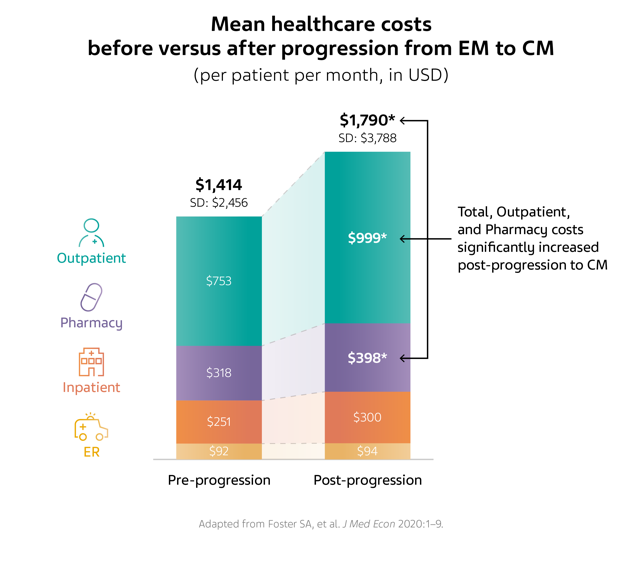
Figure 1. All-cause healthcare costs, separated by medical service type, pre- and post-progression from episodic migraine (EM) to chronic migraine (CM). Reported as mean per patient per month (PPPM) in United States dollars (USD). * Significantly (p<0.0001) different from pre-progression. SD: standard deviation.
With regards to migraine progression risk factors, younger age, female sex, chronic pain, and use of triptans, butalbital, anticonvulsants or other non-specific acute medications of interest were significantly associated with increased risk of progression.
The scrutiny
This study utilized a large US health insurance database to yield real-world data elucidating how migraine progression affects HCRU and costs. However, such data from a claims database include incident and prevalent cases, treated and untreated patients, and is subject to coding biases and errors that could confound the findings. Additionally, patients 65 years of age and older are underrepresented in the IQVIA database and patients who are uninsured or participate in Medicare or Medicaid are not included in this study, limiting the generalizability of the results.
Generalizability may also be impacted by the absence of information regarding non‑prescription drug use. Further, since 15 or more claims of acute migraine medication defines progression to CM, this study may exclude patients who have a plan limit on the number of prescription claims allowed. However, a strength of utilizing the claims database is that migraine progression was not based on self-reported data as it has been described in other studies.3
It is also notable that comorbidities such as hypertension and dyslipidemia were associated with a slightly lower risk of progression or no progression in the current study, contradictory to previous reports.4,5 This inconsistency could be due to the inclusion of migraine medications that may also be used to treat these conditions in the regression model used in this study, modifying the effect of the comorbidity on migraine progression to CM.

The next questions
- How can risk factors for migraine progression be harnessed to develop prevention strategies that could reduce economic burden?
- What are the optimal treatment strategies for migraine progression to lessen the economic impact on patients and healthcare systems?
- What other methods can be used to decrease HCRU and costs for patients at risk of migraine progression?

The bottom line
Similar to studies reporting the increased economic burden of CM compared to EM2, these findings demonstrate that migraine progression is associated with increased HCRU and total all-cause costs across different medical service types. Several factors were identified that likely increase progression risk such as younger age, female sex, chronic pain, and use of certain acute or preventive medications. These results emphasize the substantial economic burden facing patients and healthcare systems during and after progression from EM to CM. This study also stresses the importance of developing improved prevention and treatment strategies.
References
- Bigal ME, Serrano D, Reed M, Lipton RB. Chronic migraine in the population: burden, diagnosis, and satisfaction with treatment. Neurology 2008;71:559-66.
- Stokes M, Becker WJ, Lipton RB, et al. Cost of health care among patients with chronic and episodic migraine in Canada and the USA: results from the International Burden of Migraine Study (IBMS). Headache 2011;51:1058-77.
- Bigal ME, Serrano D, Buse D, Scher A, Stewart WF, Lipton RB. Acute migraine medications and evolution from episodic to chronic migraine: a longitudinal population-based study. Headache 2008;48:1157-68.
- Barbanti P, Aurilia C, Egeo G, Fofi L. Hypertension as a risk factor for migraine chronification. Neurol Sci 2010;31 Suppl 1:S41-3.
- Janoska M, Chorazka K, Domitrz I. Migraine frequency and its association with dyslipidemia in women. Neurol Neurochir Pol 2015;49:95-8.
NPS-US-NP-01543


